“Let’s just use the highest gain antenna. More gain means longer range. Problem solved.”
It sounds logical.
And on paper, it almost makes sense.
But in real RFID deployments, higher gain does not automatically mean better performance.
Sometimes it actually makes things worse.
Let’s break it down in a practical way.
What Does RFID Antenna Gain Actually Mean?
Antenna gain, usually expressed in dBi, describes how focused the RF energy is.
Important detail:
Gain does not mean the antenna creates more power.
The reader still outputs the same power.
The antenna simply shapes how that energy spreads.
Think of it like this:
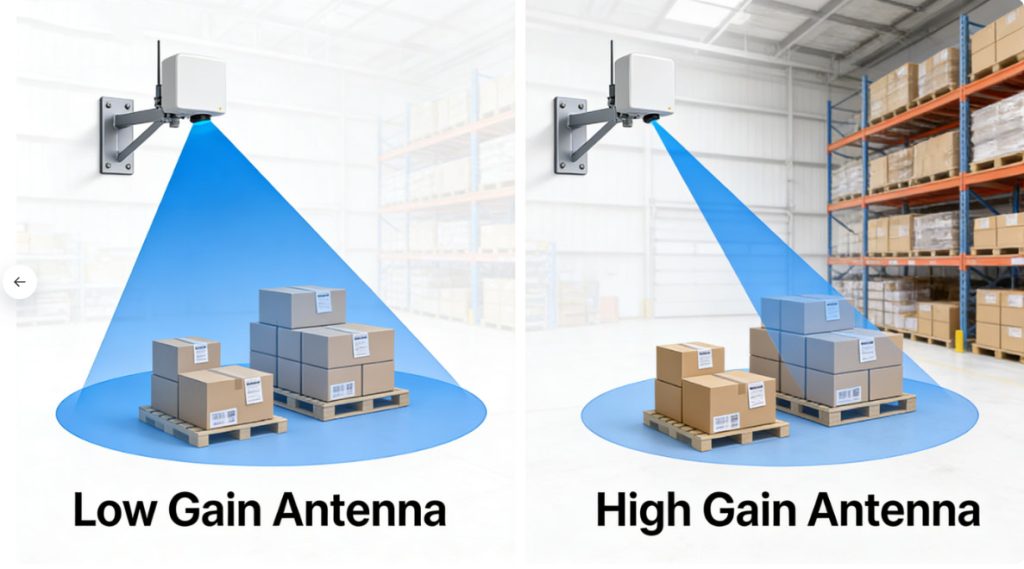
- Low gain = wide floodlight
- High gain = narrow spotlight
The total light energy is similar — it’s just distributed differently.
Same idea with RF.
Higher Gain = Narrower Beam
This is the part many people overlook.
When gain increases:
• The signal travels farther
• The beam becomes narrower
• Coverage becomes more directional
So yes, a 12 dBi antenna may read farther than a 6 dBi antenna.
But it will also cover a much smaller area.
If your tags move unpredictably, a narrow beam can actually reduce read rates.
Real Example: Warehouse Dock Door
Imagine a pallet entering a dock door.
Tags may face:
Front
Side
Slightly angled
Partially blocked
If you install a very high gain antenna pointing straight forward, it creates a long, narrow RF tunnel.
If the pallet shifts slightly off center, some tags may fall outside the beam.
In that case, a medium gain antenna (8–9 dBi) often performs better because the coverage area is more forgiving.
When High Gain Actually Helps
There are situations where higher gain is useful.
For example:
• Long corridor tracking
• Yard management
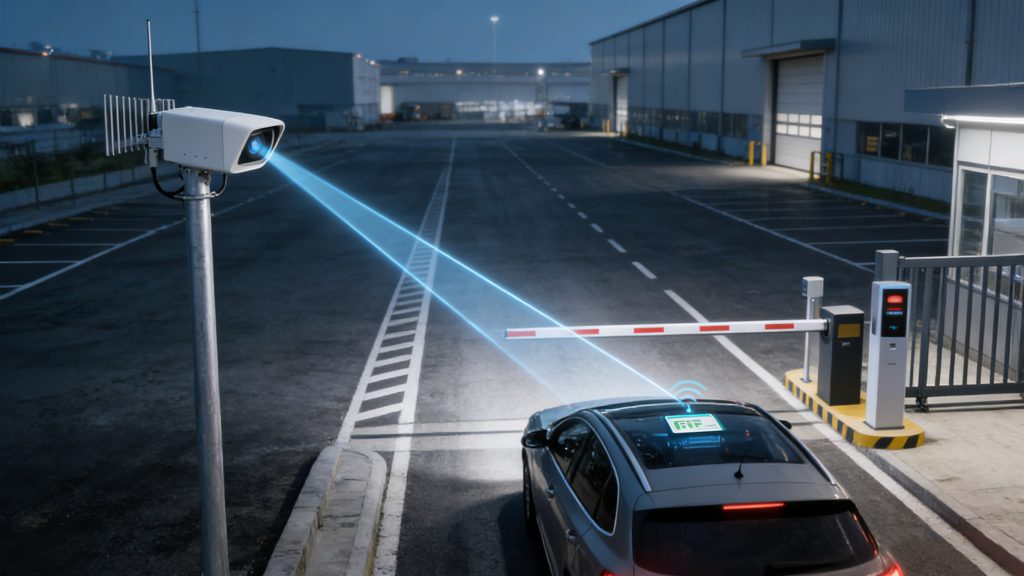
• Vehicle entry checkpoints
• Outdoor fixed-direction reading
If the tag path is predictable and controlled, high gain works beautifully.
It creates distance and precision at the same time.
The key word here is controlled.
When High Gain Causes Problems
Here’s where things go wrong.
- Reading unwanted tags
A high gain antenna may read tags far outside the intended zone — including pallets nearby or inventory behind walls.
- Reflection issues
In metal-heavy environments, narrow beams reflect strongly off surfaces, causing multipath interference.
- Overlapping read zones
In multi-antenna systems, high gain beams can overlap unpredictably, reducing system stability.
Ironically, trying to increase performance sometimes increases noise.
Typical Gain Ranges in UHF RFID Systems
In most industrial deployments, you’ll see:
6 dBi
Short range, wide coverage
8–9 dBi
Balanced and most common
10–12 dBi
Long-range, focused applications
For warehouse and indoor systems, 8–9 dBi antennas are often the safest starting point.
If you’re reviewing industrial rfid antenna models designed for these scenarios, you can explore typical specifications here
Gain vs Reader Power
Another common misunderstanding:
People try to increase both gain and reader power.
But regulatory limits apply (like FCC in the U.S.).
Increasing gain effectively increases EIRP (Effective Isotropic Radiated Power).
So higher gain may require lowering reader output to stay compliant.
This is something many first-time integrators overlook.
The Better Question to Ask
Instead of asking:
“What’s the highest gain antenna available?”
Ask:
“What shape should my read zone be?”
Do you want:
A wide detection area?
A narrow tunnel?
A short, controlled gate?
A long directional corridor?
Once you answer that, the right gain level becomes obvious.
Final Thoughts
Higher gain does not mean better RFID performance.
It means more focused RF energy.
In controlled environments, that’s powerful.
In dynamic environments, it can become a limitation.
The best RFID systems are not built with the strongest components.
They’re built with the right components, placed correctly.
And antenna gain is one of the most important pieces of that puzzle.